
Phase I
Objectives
define safety of Ganetespib in a new combination with the taxane Paclitaxel
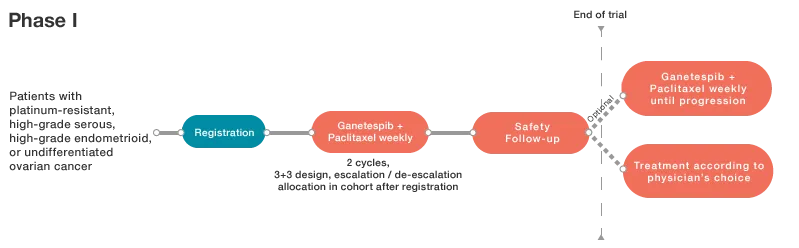
PHASE I DOSE ESCALATION / DE-ESCALATION STUDY
Phase I will be open at Medizinische Universität Insbruck, Charité – Universitätsmedizin Berlin, Universitätsklinikum Hamburg-Eppendorf and Centre Anticancereurx Leon Berard via their respective national trial groups (AGO Research GmbH, Nord-Ostdeutsche Gesellschaft für Gynakologische Onkologie e.V., ARCAGY Association) and in the single high-volume University centre Leuven. This will ensure fast patient enrolment. Phase I covers a timeframe of 10 months (6-8 months active enrolment, remaining time for follow-up).
An estimated number of 9-18 platinum-resistant high-grade serous, high-grade endormetrioid, or undifferentiated ovarian cancer patients will take part in the dose escalation/de-escalation study with a traditional 3+3 design. There will be no intra-patient dose escalation. The first 3 patients will be treated with a starting dose of 100 mg/m2 Ganetespib and the standard dose of Paclitaxel weekly (80 mg/m2, fixed dose). If this dose does not cause significant adverse effects in the first cohort during cycle 1 (weeks 1-4), Ganetespib will be escalated to 150 mg/m2, as a second cohort takes part in the study. If the dose of 150 mg/m2 does not cause significant adverse effects, it will be used in the GANNET53 Phase II trial. In the unexpected case of significant adverse effects at 150 mg/m2, a dose reduction of Ganetespib to 125 mg/m2 is permitted. The observation period will last from the first day of cycle 1 to the last day of cycle 2. At the dose level going to be used in Phase II an additional cohort of 3 patients will be included. Each patient will receive 2 cycles of experimental therapy. All patients may continue to receive Ganetespib in combination with paclitaxel until progression if a benefit for the patient has been observed. Patients who did not appear to have had a benefit of the combination therapy will be treated according to physician‟s choice.
Study Type: Interventional; Study Design: Single group assignment; open label; Estimated Enrolment: 9-18 patients
Phase II
Objectives
determine efficacy of the combination of Ganetespib and Paclitaxel weekly in comparison to Paclitaxel weekly alone in patients with platinum resistant high grade serous or high grade endometrioid or undifferentiated ovarian cancer
further define safety of Ganetespib in combination with the taxane Paclitaxel
collect biomaterials for molecular efficacy testing of Ganetespib and for p53 status analysis
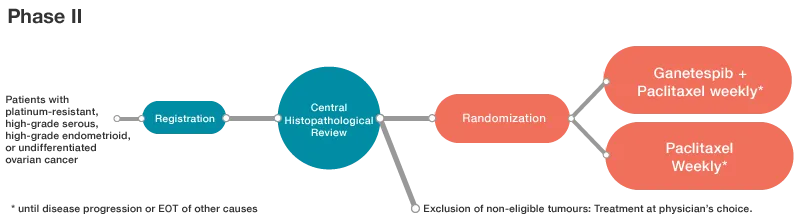
RANDOMISED, TWO ARM PHASE II STUDY
Phase II will be open nation-wide in Austria, Germany and France via the respective national trial groups with their assigned centres and at the single high-volume University Centre Leuven, Belgium to ensure sufficient enrolment. Phase II covers a total time frame of 4 years (2.5 years of active enrolment, 1.5 years of follow-up).
SYNOPSIS: Eligible patients will undergo central histopathological review (Charité – Universitätsmedizin Berlin) of archival ovarian cancer tissue at primary diagnosis to ensure high-grade serous, high-grade endometrioid, or undifferentiated histology of tumours. 200 patients with elegible histological subtypes will be randomised in a 2:1 ratio (222 patients: 148 + 74) to receive either Ganetespib and Paclitaxel weekly or Paclitaxel weekly alone. The Ganetespib dose used depends on results of Phase I. For Paclitaxel weekly the standard dose of 80 mg/m2 is applied. Patient will receive the respective therapy until disease progression. All patients included will be analysed for p53 mutational status from archival ovarian cancer tissues at primary diagnosis. This analysis will be performed during ongoing Phase II.
Study Type: Interventional; Study Design: Randomised, parallel assignment, open-label Estimated Enrolment: 222 patients.
EUDRACT Nr: 2013-003868-31
Patient Recruitment Strategy
The GANNET53 trial is a Europe-wide multi-centre clinical trial, involving national trial groups to safeguard sufficient enrolment of patients.
The GANNET53 trial will be open nation-wide in Austria, Germany and France via the respective national trial groups and at the high-volume University Centre Leuven in Belgium.
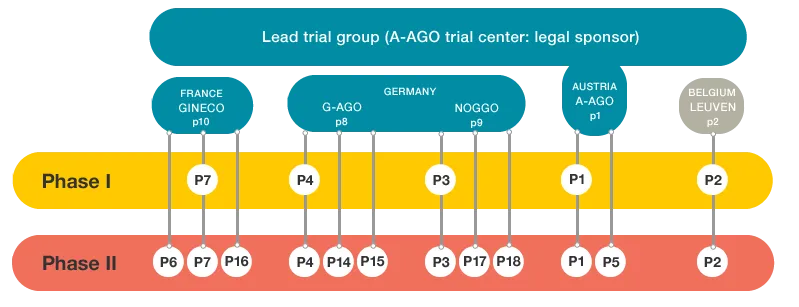
National trial groups include:
A-AGO (Austrian Gynaecological Oncology Trial Group) with its trial centre at Innsbruck Medical University (P1 covering Austria)
G-AGO (German Gynaecological Oncology Trial Group; P8) covering mainly western Germany
NOGGO (North-Eastern German Society of Gynaecological Oncology; P9) covering north-eastern Germany
GINECO (Groupe d’Investigateurs Nationaux pour l’Étude des Cancers Ovariens et du Sein; P10) covering France
Translational Research
Biobank
Objectives
Develop a database for biosample collection (virtual tumour bank) and biosample tracking
Organise prospective and retrospective collection, deposition and delivery of biomaterials
Provide Central Histopathological Review (CHR) to ensure the inclusion of solely Type II tumours into Phase II and to ensure tissue sample quality for experimental work
A data handling system dedicated to biobanking and biosample tracking will be developed. This database will be manufactured by xailabs GmbH in close cooperation with Charité – Universitätsmedizin Berlin and Medizinische Universität Insbruck.
The data handling systems will be accessible from virtually any internet-ready device, allowing the users to access the information they need and to which they have rights anytime, from anywhere, with no plug-ins, downloads or applets. Systems will fully respect the Good Clinical Practice (GCP) and national regulations.
Data security and storage: All data communication is encrypted, using advanced encryption technologies [Secure Socket Layer (SSL) for secure transmission, digital certificates for server identification]. All data is secured against hardware failures and systematic back-ups are made at defined intervals (daily, weekly and monthly back-ups).
Companion Diagnostics
Objectives
Determine the exact p53 status in Phase II patients
Perform molecular efficacy testing: (1) a functional molecular test (proximity ligation assay) will be developed and evaluated for its value to predict responsiveness to Ganetespib. (2) CTC analysis before and during experimental therapy will be performed and evaluated for its value to monitor responsiveness to Ganetespib.
Mouse Models and Human Xenografts
Objectives
Provide the most stringent in vivo genetic and pharmacologic proof-of-principle for the underlying treatment concept in engineered mutp53 knock-in mice.
Stringently test the Ganetespib-mediated preferential killing of mutp53 cancer cells in human ovarian cancer models (cultured cells and nude mice).